Logistics Agency, Logistics
under 1 hour (a 50% reduction)
Route planning time per dispatcher
from 2–3 hours
Dispatcher copilot across 200+ daily routes
Dispatcher copilot, SMS agent, Email agent
6 weeks
Plainbuilt is a custom software development company for service businesses: an engineering practice since 2014, 200+ shipped projects, and we build the systems our AI runs on. We build web platforms, mobile apps, websites that book jobs, and CRM and CMS integrations in Next.js, React Native, Supabase and Postgres, Node, and Twilio. Every build carries a written ROI commitment.
The system the whole operation works in: jobs, crews, schedule, quotes, customers, on the web and on every device. Built in Next.js on Supabase, Postgres, and Node.
Field-technician, booking, dispatch, estimating, and owner apps in React Native, wired into the systems you already run.
The site, an AI chatbot that answers from your own content, and quote automation, sold as one package and wired into ServiceTitan or Jobber.
Custom ServiceTitan, Jobber, and HubSpot integrations, and the link between your site or app and the system that runs the jobs.
Applied AI on foundation models: voice, chat, SMS, and email agents, retrieval over your own data, and AI inside the app you already run, wired into the systems you run.
Next.js, React Native, Supabase/Postgres, Node, Twilio
We start with the operation, not the software: what runs through spreadsheets, group texts, and one person's memory today. The 30-minute working session opens it.
We write down what gets built, what it is wired into, and the number the written ROI commitment measures. The spec is the build plan.
We build in Next.js, React Native, Supabase and Postgres, Node, and Twilio, against the real systems you already run.
The software ships into your live operation and runs with real traffic and the people who will use it.
We keep it running after it ships: fixes, updates, and the next features when you want them.
Four builds and the AI half of the same practice, each with its own page. Web platforms are the practice this site and our flagship, the ops platform for contractors, are built in. Mobile apps ship for iOS and Android in React Native. Websites that book jobs are the smallest build we offer and the one we lead with. CRM and CMS integrations move data once, in the right direction, on the right trigger: a job booked on the website lands in ServiceTitan, and a customer created in Jobber shows up in HubSpot with the deal. The fifth page, AI development, is the AI half: agents, retrieval over your own data, and AI inside the app you already run.
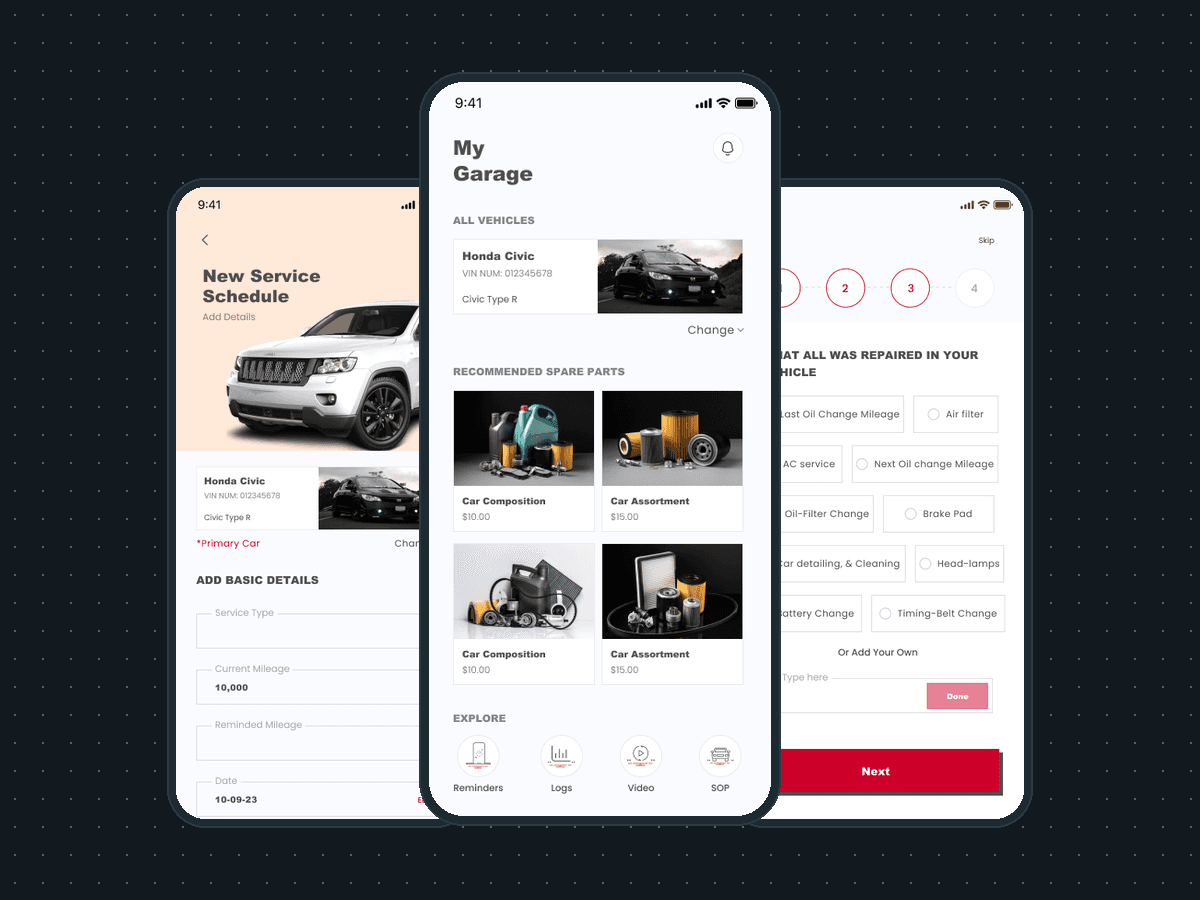
As of September 2026 the portfolio holds 41 published items: 40 named with the client's permission, by the product or business on the screens, and 1 anonymized. By category: 14 marketplace, live-event, and community apps, 8 customer booking and self-service apps, 7 patient intake apps, 4 owner assistant apps, 2 crew scheduling apps, 2 real estate apps, and one each of field-technician, fleet and dispatch, estimating and quoting, and IoT companion apps. On 40 of the 41 Plainbuilt's role was full-stack development: 28 mobile and web apps, each delivered as a fully built app in under 6 months, and 12 websites and landing pages, designed and built. The other is a product design engagement, 19 screens in 2 months. The pages show the real screens and count them: AutoAide, a car-care app for owners and technicians, 45 iOS screens; iNROADS, a truck-booking app with a shipper side and a driver side, 16 iOS screens; Mr. Brightside, a roofing contractor's website, one home page in 3 hero directions. No portfolio page claims an app is live today, and none carries a metric, a rating, or a download count: the outcome is the delivered build.
Five questions, with our answers where the site has them. Who owns the code, the repository, and the hosting accounts when the build ships: Set out in the agreement. Fixed price or time and materials, and how a change request is priced: Pricing on request. Who does the work: our team, led by Plainbuilt's founder and three co-founders, with the engineering center in India (about Plainbuilt). What you get in writing: the spec names the number the software is built to move, every deployment carries a written ROI commitment, and if a workflow underperforms its projection by 20% or more we redesign on our dime (the commitment, annotated). What happens after go-live: 30 days of post-launch support, then an optional monthly retainer, and a kill switch on every deployment (the FAQ).
Yes, and it should be one team, because the AI has to run somewhere. A voice agent that books into ServiceTitan is an integration first (CRM and CMS integrations); a website that books jobs ships with the chatbot and quote automation as one package; and adding AI to an existing app means putting a language model to work inside the software you already run, behind an adapter, with your data staying in your systems. This site runs in the same stack as every build, Next.js on Supabase, Postgres, and Node, and so do our own AI systems, so the practice that ships your platform is the one that wires the agent into it.
Logistics Agency, Logistics
under 1 hour (a 50% reduction)
Route planning time per dispatcher
from 2–3 hours
Dispatcher copilot, SMS agent, Email agent
6 weeks
Details to follow
The agents and automations are what we deploy. Behind them are 40 apps and websites Plainbuilt designed and built full stack: the proof that the software side is in-house too.
Yes, for service businesses, and an engineering practice since 2014 with 200+ shipped projects. We build web platforms, mobile apps, websites that book jobs, and CRM and CMS integrations in Next.js, React Native, Supabase and Postgres, Node, and Twilio, the stack our own AI runs on, and every build carries a written ROI commitment. The portfolio shows the apps and websites with their real screens.
Four things: web platforms, mobile apps, websites that book jobs for service businesses, and CRM and CMS integrations. The same engineering practice has shipped 200+ projects since 2014, and it builds the systems our own AI runs on; the AI development page is the AI half of the same practice.
Next.js for the web, React Native for mobile, Supabase and Postgres for the data, Node for the services behind it, and Twilio for calls and texts. One stack, the one we ship everything in, wired into whatever your operation already runs on.
Five steps: discovery, spec, build, ship, support. The 30-minute working session opens discovery. The spec that follows is the build plan: what gets built, what it is wired into, and the number the written ROI commitment measures. Then we build, ship into your live operation, and keep it running.
Yes. Every deployment carries a written ROI commitment, and a custom build is a deployment. The spec names the number the software is built to move, and that number is what we measure after it ships.